
E Governance-- applications, models, successes, limitations, and potential
In the arena of advanced technology, e-government has distinct place and it facilitates to huge number of customers to perform their task speedily. As the Internet supported digital communities grow, they present the national governments with numerous challenges and opportunities. e-Governance which also known as electronic governance is basically the application of Information and Communications Technology to the processes of Government functioning in order to bring about 'Simple, Moral, Accountable, Responsive and Transparent' governance (Governance for The Tenth Five Year Plan (2002-2007), Planning Commission, November, 2001 ). E governance involve the use of ICTs by government organisations for Exchange of information with citizens, businesses or other government departments, Faster and more efficient delivery of public services, Improving internal efficiency, Reducing costs / increasing revenue, Re-structuring of administrative processes and Improving quality of services.
Concept of e-Governance:
E governance has gained more popularity in convoluted business world. Many management scholars have described the concept of e governance which is emerging as an important activity in the business field. It is established that E-governance is the application of information and communication technologies to transform the efficiency, effectiveness, transparency and accountability of informational and transactional exchanges with in government, between government & govt. agencies of National, State, Municipal and Local levels, citizen & businesses, and to empower citizens through access & use of information (Mahapatra, 2006).
World Bank explained the E governance as the use by government agencies of information technologies (such as Wide Area Networks, the Internet, and mobile computing) that have the ability to transform relations with citizens, businesses, and other arms of government. These technologies can serve a variety of different ends: better delivery of government services to citizens, improved interactions with business and industry, citizen empowerment through access to information, or more efficient government management. The resulting benefits can be less corruption, increased transparency, greater convenience, revenue growth, and or cost reductions."
According to international organization, UNESCO, "Governance refers to the exercise of political, economic and administrative authority in the management of a country's affairs, including citizens' articulation of their interests and exercise of their legal rights and obligations. E-Governance may be understood as the performance of this governance via the electronic medium in order to facilitate an efficient, speedy and transparent process of disseminating information to the public, and other agencies, and for performing government administration activities". The Council of Europe elaborated e-Governance as "the use of electronic technologies in three areas of public action such as relations between the public authorities and civil society, functioning of the public authorities at all stages of the democratic process (electronic democracy) and the provision of public services (electronic public services).
E governance:
Dr. APJ Abdul Kalam, former President of India, has envisaged e-Governance in the Indian framework as "A transparent smart e-Governance with seamless access, secure and authentic flow of information crossing the interdepartmental barrier and providing a fair and unbiased service to the citizen."
Historical review and current position of e-governance: It has been documented that in the decade of nineties, there was major Global shifts towards increased deployment of IT by governments due to emergence of the World Wide Web. The technology as well as e-governance enterprises have come a long way since then. With the upsurge in Internet and mobile connections, people are learning to utilize their new mode of access in various ways. They have started expecting more and more information and services online from governments and corporate organizations to advance their public, professional and personal lives.
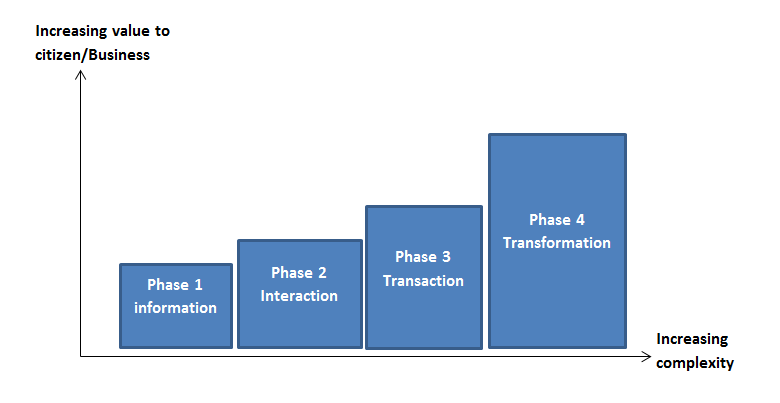
E governance maturity model ( Source: Garnter, 2000)
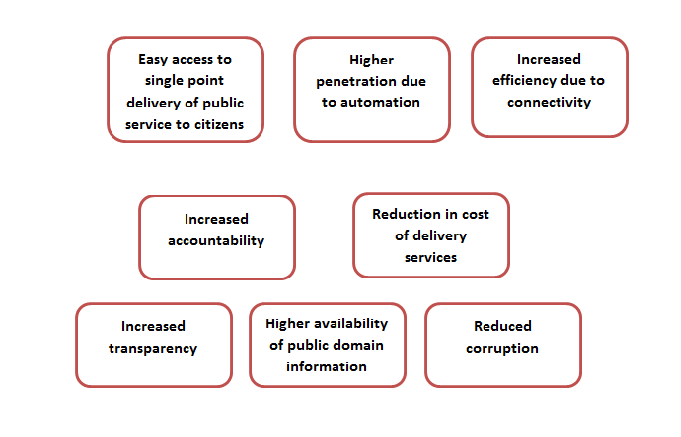
Objectives of E governance: The tactical objective of e-governance is to support and streamline governance for all parties such as government, citizens and businesses through effective use of ICTs.
E-governance evolution in India: The notion of e-governance evolved in India during the seventies with a focus on development of in-house government applications in the areas of defence, economic monitoring, planning and the deployment of information technology to manage data intensive functions related to elections, census, and tax administration. In Indian scenario, there was great efforts of the National Informatics Center (NIC) to join all the district headquarters during the eighties. In the beginning of nineties, IT technologies were improved by ICT technologies to extend its use for broader sectorial applications with policy emphasis on reaching out to rural areas and taking in greater inputs from NGOs and private sector as well. There has been an increasing involvement of international donor agencies under the framework of e-governance for development to catalyse the expansion of e-governance laws and technologies in developing nations.
Stages of e-Governance:
It is apparent in various research studies that e-Governance is fundamentally linked with the development of computer technology, networking of computers and communication systems. In developing nations such technologies and systems became available with observable time lag as compared to developed nations. When appraising the e governance model in India, it is established that with the liberalization of the economy from the early 1990s onwards, there has been a convergence in the availability of progressive technologies and opportunities in this field. The inception of e-Governance proceeded through four stages in India.
- Computerisation: In the first stage, with the availability of personal computers, majority of Government offices are well equipped with computers. The use of computers began with word processing, quickly followed by data processing.
- Networking: In this stage, some units of a few government organizations are connected through a hub leading to sharing of information and flow of data between different government entities.
- On-line presence: In the third stage, with increasing internet connectivity, a need was felt for maintaining a presence on the web. This resulted in maintenance of websites by government departments and other entities. Generally, these web-pages/ web-sites contained information about the organizational structure, contact details, reports and publications, objectives and vision statements of the respective government entities.
- On-line interactivity: A natural significance of on-line presence was opening up of communication channels between government entities and the citizens, civil society organizations etc. The main objective of this stage was to lessen the scope of personal interface with government entities by providing downloadable Forms, Instructions, Acts, Rules.
It has been observed that there was more emphasis on automation and computerization, state governments have also endeavoured to use ICT tools into connectivity, networking, setting up systems for processing information and delivering services. At a micro level, this has ranged from IT automation in individual departments, electronic file handling and workflow systems, access to entitlements, public grievance systems, service delivery for high volume routine transactions such as payment of bills, tax dues to meeting poverty alleviation goals through the promotion of entrepreneurial models and provision of market information. The push has varied across initiatives, with focusing on facilitating the citizen-state interface for various government services, and others focusing on bettering livelihoods. Every state government has taken the initiative to form an IT task force to outline IT policy document for the state and the citizen charters have started appearing on government websites.
Interactions in e-Governance:
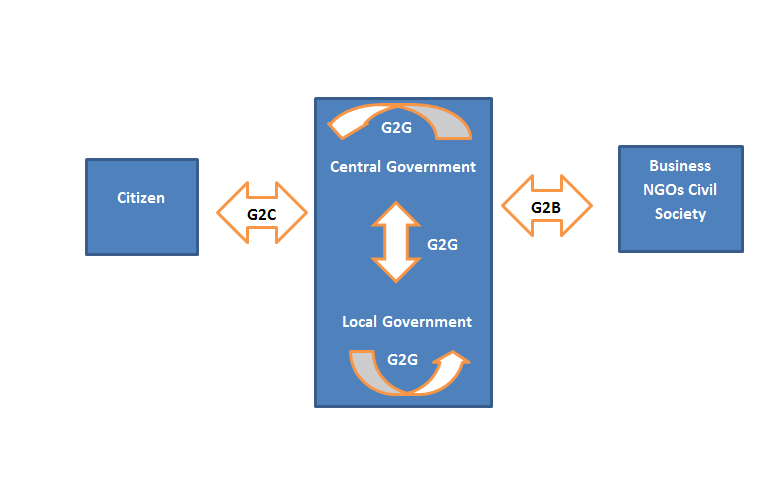
The three abbreviations in the figure, G2C, G2B and G2G.
|
e-Democracy |
e-Government |
|||
External |
|
|
|
||
G2C: Government to Citizen |
X |
X |
|
||
G2B: Government to Business |
|
X |
|
||
Internal |
|
|
|
||
G2G: Government to Government |
|
X |
|
||
E-Governance enables interaction between different stake holders in governance.
- G2G (Government to Government): In this interaction, Information and Communications Technology is used to reorganize the governmental processes involved in the functioning of government entities as well as to increase the flow of information and services within and between different entities. Gregory (2007) indicated that G2G is the online communications between government organizations, departments and agencies based on a super-government database. This kind of interaction happen horizontally such as between different government agencies as well as between different functional areas within an organisation, or vertical such as between national, provincial and local government agencies as well as between different levels within an organisation. Main intent of this interaction is to increase efficiency, performance and output.
- G2C (Government to Citizens): G2C maintains the relationship between government and citizens. It allows citizens to access government information and services promptly, conveniently, from everywhere, by use of multiple channels. Government-to-Citizens (G2C) model have been designed to facilitate citizen interaction with the government. In this situation, an interface is generated between the government and peoples which enables the citizens to benefit from efficient delivery of array of public services. This expands the availability and accessibility of public services on the one hand and improves the quality of services on the other. In G2C model, clienteles have instant and convenient access to government information and services from everywhere anytime, via the use of multiple channels. Additionally, to make certain transactions, such as certifications, paying governmental fees, and applying for benefits, the ability of G2C initiatives to overcome possible time and geographic obstacles may connect citizens who may not otherwise come into contact with one another and may in turn facilitate and increase citizen participation in government (Seifert, 2003).
- G2B (Government to Business): In this type of interaction, e-Governance tools are used to help the business organizations that provide goods and services to seamlessly interact with the government. G2B can bring significant efficiencies to both governments and businesses. G2B include various services exchanged between government and the business sectors that include distribution of policies, memos, rules and regulations. Business services offered include obtaining current business information, new regulations, downloading application forms, lodging taxes , renewing licenses, registering businesses, obtaining permits, and many others (Pascual, 2003). The major aim of this interaction is to cut red tape, save time, reduce operational costs and to create a more transparent business environment when dealing with the government.
- G2E (Government to Employees): G2E denotes to the relationship between government and its employees only. The aim of this relationship is to serve employees and offer some online services such as applying online for an annual leave, checking the balance of leave, and reviewing salary payment records, among other things (Seifert, 2003). In this case, Government is major employer and it has to interact with its employees on a regular basis. This interaction is a two-way process between the organisation and the employee. Use of ICT tools helps in making these interactions fast and efficient on the one hand and increase satisfaction levels of employees on the other.
Interactions between main groups in e-governance
E-Governance implemented by government of India, allows for government transparency. Government transparency is significant because it allows the public to be informed about what the government is working on as well as the policies they are trying to implement. It encourages accountability in all government dealings, in recent times many Indian states have come up with various e Governance patterns to expedite smooth functioning in their daily administrative activities.
Though extreme efforts have been made to develop infrastructure and internal information handling by government officials as well as public services, the diffusion of technologies in moving towards e-governance have been slow. There are some reason for sluggishness.
- Lack of IT Literacy and awareness regarding benefits of e-governance: There is lack of awareness regarding benefits of e-governance projects. The administrative structure is not geared for maintaining, storing and retrieving the governance information electronically. The general tendency is to obtain the data from the files as and when required instead of using Document Management and workflow technologies.
- Underutilization of existing ICT infrastructure: Second reason is that the computers in the department are used for word processing only, resulting in the underutilization of the computers in terms of their use in data mining for supporting management decisions. The time gap between the procurement of the hardware and development of the custom applications is so large that by the time application is ready for use, the hardware becomes out-dated.
- Attitude of Government Departments: Government officials have different attitude as compared to private sectors. Conventionally the government executives have derived their sustenance from the fact that they are important repositories of government data. Thus any effort to implement DMS and workflow technologies or bringing out the change in the system is met with resistance from the government servants.
- Lack of coordination between Government Department and Solution developers: Designing of any application requires a very close interaction between the government department and the agency developing the solutions. Currently, the users in govt. departments do not make efforts to design the solution architecture. Subsequently, the solution developed and implemented does not address the requirements of an e-governance project and hence does not get implemented.
- Resistance to re-engineering of departmental processes: Many experts have stated that in order to implement e-governance projects successfully, executives must make efforts in restructuring in administrative processes, redefining of administrative procedures and formats which finds the resistance in almost all the departments at all the levels. Moreover, there is lack of expertise of departmental MIS executives in exploiting data mining techniques, updating and collection of real time content onto website. Therefore the content as is collected or maintained by various e-governance portals is unreliable or full of gaps. In such a situation, it is difficult for any e-governance solution to accomplish its anticipated results.
- Lack of Infrastructure for sustaining e-governance projects on national level: In Indian scenario, Infrastructure to support e-governance initiatives does not exist within government departments. The frustrating fact is that the government departments are not prepared to be in a position to project the clear requirements nor are there any guidelines for involving private sector. The infrastructure creation is not guided by a constant national policy, but is dependent on the needs of individual officers championing a few projects. Therefore, the required networking and communication equipment is either non-existent in government departments, or if it exists at all, it does not serve any concrete purpose as far as the requirement of e-governance project is concerned. The use of connectivity options provided by govt. agencies are used in a very limited manner for data transmission purpose between various locations.
Most state government have established the IT task force and have their IT policies in place. Although policies may have supercilious goals, much seems to have happened only in automation and computerization. The disadvantage is that these IT policy documents are not made based upon the requirements and intrinsic capabilities of the state but are based on the surveys and strategies used by other nations or other states.
A tentative action plan is presented to help implement the e-governance initiatives as under:
E-Governance Action Plan in India: Government officials in India have realized that e-governance is vital technology for economic progress of country in highly competitive environment. It requires an increased participation from citizens. Providing services online is no longer going to remain optional for local and central government as demand for providing services @ internet speed has been coming from the citizens. In this period of accountability and performance measurement, government will face huge pressure to make the services more accessible to their inhabitants. The pressure comes directly from the new legislatures and govt. policies to implement high-end technologies in governing the nations; but also indirectly and perhaps more intensely from citizens.
E-governance is about more than streamlining processes and improving services. It plays major role in transforming Governments and renovating the way citizens participate in democracy.
For governments, the more overt inspiration to shift from manual processes to IT-enabled processes to increase efficiency in administration and service delivery, the will be visible to all. This change can be conceived as a valuable investment with huge returns.
Some of the recent e-governance projects are implemented by various state government.
Some E-governance Initiatives |
|
State/Union Territory |
Initiatives covering departmental automation, user charge collection, delivery of policy/programme information and delivery of entitlements |
Andhra Pradesh |
e-Seva, CARD, VOICE, MPHS, FAST, e-Cops, AP online—One-stop-shop on the Internet, Saukaryam, Online Transaction processing |
Bihar |
Sales Tax Administration Management Information |
Chattisgarh |
Chhattisgarh Infotech Promotion Society, Treasury office, e-linking project |
Delhi |
Automatic Vehicle Tracking System, Computerisation of website of RCS office, Electronic Clearance System, Management Information System for Education etc |
Goa |
Dharani Project |
Gujarat |
Mahiti Shakti, request for Government documents online, Form book online, G R book online, census online, tender notice. |
Haryana |
Nai Disha |
Himachal Pradesh |
Lok Mitra |
Karnataka |
Bhoomi, Khajane, Kaveri |
Kerala |
e-Srinkhala, RDNet, Fast, Reliable, Instant, Efficient Network for the Disbursement of Services (FRIENDS) |
Madhya Pradesh |
Gyandoot, Gram Sampark, Smart Card in Transport Department, Computerization MP State Agricultural Marketing Board (Mandi Board) etc |
Maharashtra |
SETU, Online Complaint Management System—Mumbai |
Rajasthan |
Jan Mitra, RajSWIFT, Lokmitra, RajNIDHI |
Tamil Nadu |
Rasi Maiyams–Kanchipuram; Application forms related to public utility, tender notices and display |
North-Eastern States |
|
Arunachal Pradesh, |
Community Information Center. Forms available on |
Manipur, Meghalaya, |
the Meghalaya website under schemes related to |
Mizoram & Nagaland |
social welfare, food civil supplies and consumer affairs, housing transport etc. |
Advantages of E governance: e-Governance is improvement in governance which is enabled by the resourceful use of Information and Communications Technology. E governance bring better access to information and excellence services for inhabitants. It also makes simplicity, efficiency and accountability in the government. Through the use of ICT to governance combined with comprehensive business process reengineering would lead to simplification of complicated processes, simplification in structures and changes in statutes and regulations. E governance is advantageous to citizens and government as rapid growth of communications technology and its adoption in governance would support to bring government machinery to the doorsteps of the citizens.
There are many challenges in implementing E governance model in India as well as at global scale. The actual challenge is how to develop and withstand successful e-governance projects and deliver state of the art e-services to inhabitants. Unfortunately, it is not as easy to develop e governance website in service delivery mechanism. Efficacious e-governance initiatives can never be taken in hurriedness. With reference to India, e-Governance should enable seamless access to information and seamless flow of information across the state and central government.
There are several security drawbacks of an E-Governance mechanism.
- Spoofing: In this practice, the attacker attempts to gain the access of the E-Governance system by using fallacious identity either by stealth or by using false IP address. Once the access is gained, the assailant abuses the E-Governance system by elevation of the privileges.
- Tampering of E-Governance system: As soon as the system is compromised and privileges are raised, the classified information of the E-Governance mechanism becomes very much susceptible to illegal adjustments.
- Repudiation: Even the attacker can mount refutation attack during the E-Governance transaction, which is the ability of the user to reject its performed transaction.
- Disclosure of E-Governance Information: In case of the compromised E-Governance system, the undesirable information disclosure can take place very easily.
- Denial of Service: In this technique, attacker can perform Denial of Service (DoS) attack by flooding the E-Governance server with request to consume all of its resources so as to crash down the mechanism.
- Elevation of privilege: Once an E-Governance system is compromised; the attacker pretending to be a low profile user attempts to escalate to the high profiles so as to access its privileges to initiate further damage to the system.
- Cyber Crimes: Advancement of science and technology increase the rate of the cybercrime. It is a threat to the transactions accomplished between the Government and its Citizenry within the E-Governance methodology.
Requirements for implementing successful e-governance across the nation are:
- e-Governance framework across the nation with enough bandwidth to service a population of one billion.
- Connectivity framework for making the services to reach rural areas of the country or development of alternative means of services such as e-governance kiosks in regional languages.
- National Citizen Database which is the primary unit of data for all governance vertical and horizontal applications across the state and central governments.
- E-governance and interoperability standards for the exchange of secure information with non-repudiation, across the state and central government departments seamlessly.
- A secure delivery framework by means of virtual private network connecting across the state and central government departments.
- Datacenters in centre and states to handle the departmental workflow automation, collaboration, interaction, exchange of information with authentication.
To develop successful e-governance project and superior service delivery, it is vital that the government organisation focus on whole citizen experience. Focusing on the citizen is indispensable for long term success. The government agency needs to assimilate information from all points of citizen interaction. General architecture for e-Governance needs to make certain that the architecture components are extensible and scalable to acclimate to the changing environments.
To summarize, E-governance is explained as delivery of government services and information to the public using electronic media. Such means of delivering information is often referred to as Information Technology. With the development of Information and Communications Technology, there is faster and better communication, efficient storage, retrieval and processing of data and exchange and utilization of information to its users, whether they are individuals, groups, businesses, organizations or governments.
In India, it is tough task to accomplish goals of implementing e-governance and transforming India which goes far beyond computerization of separate back office operations. Implementation of e governance will require basic change in work culture and goal orientation, and simultaneous change in the existing processes. It is necessary to create a culture of maintaining, processing and retrieving the information through an electronic system and use that information for decision making. It will need skilled navigation to ensure a smooth transition from old processes and manual operations to new automated services without hampering the existing services. This can be realised by initially moving ahead in smaller informed initiatives in a time bound manner and avoiding large and expensive steps without understanding the full social implications.