
Emotional intelligence-concepts, and their utilities and application in administration and governance
Emotional Intelligence is the summative of abilities, competencies and skills that signify a collection of knowledge in order to cope with life effectively. Therefore, it is closely related to the personal and professional growth of the individuals who have to take decisions under stressful and difficult situations. The model of emotional intelligence is a debatable topic among psychological researcher recently especially with reference to the way it affects today's workforce. Businesses are basically people, so anything that impacts the efficiency of people's minds also impacts the businesses they operate. Emotional intelligence, abbreviated as EI, refers to the ability to perceive, control and evaluate emotions. Some researchers suggest that emotional intelligence can be learned and strengthened, while others claim it is an inborn characteristic. Emotional Intelligence has generated great interest in scientific fields (Mayer & Salovey, 1997).
Concept of Emotional intelligence:
Emotional intelligence has prominence in organizational effectiveness. It is defined by psychological theorists as the ability to learn or understand or to deal with new or trying situations. The cognitive abilities of an individual to learn from experience, to reason well, and to cope effectively with the demands of daily living. Other theorists stated that Emotional intelligence involves the "capabilities to perceive, appraise, and express emotion; to access and/or generate feelings when they facilitate thought; to understand emotion and emotional knowledge; and to regulate emotions to promote emotional and intellectual growth" (Mayer & Salovey, 1997).
Historical review of Emotional intelligence
It is documented in early researches that roots of emotional intelligence can be traced back in intelligence such as Wechsler (1958) who explained intelligence as "the aggregate or global capacity of the individual to deal effectively with his environment". Wechsler had acknowledged that in addition to cognitive factors, there are also non-cognitive factors that determine intelligent behavior. In 1983, Gardner first published his theory, derived from extensive brain research, on multiple Intelligence including intrapersonal (self-awareness/self-management) and interpersonal (relationship awareness/management). Gardner argues that people have several "separate" intellectual capacities, each of which deserves to be called an intelligence. According to Gardner's work, there are seven intelligences. They are:- Linguistic intelligence
- Musical intelligence
- Logical-mathematical intelligence
- Bodily kinesthetic intelligence
- Naturalist intelligence
- Interpersonal intelligence
Gardner's renewal of social intelligence under the facade of interpersonal and intrapersonal intelligence proved a powerful push to those interested in emotional intelligence as a skill and a competency that was being ignored in the context of training and development of skilled personnel both as pupils in the school system and as producers in the context of administrative and economic systems.
There are three main models of emotional intelligence. The first model by Peter Salovey and John Mayer perceives emotional intelligence as a form of pure intelligence, that is, emotional intelligence is a cognitive ability. A second model by Reuven Bar-On visualized emotional intelligence as a mixed intelligence, consisting of cognitive ability and personality aspects. This model emphasizes how cognitive and personality factors influence general well-being. The third model, introduced by Daniel Goleman, also observes emotional intelligence as a mixed intelligence involving cognitive ability and personality aspects. However, unlike the model proposed by Reuven Bar-On, Goleman's model focuses on how cognitive and personality factors determine workplace success.
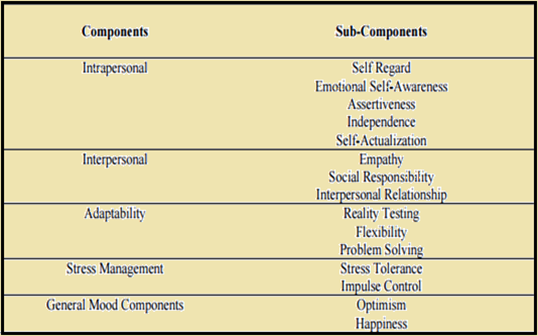
Reuven Bar-On (1988) has retained emotional intelligence in the framework of personality theory, specifically a model of well-being. Bar-On's model of emotional intelligence relates to the potential for performance and success, instead of performance or success itself, and is considered process-oriented rather than outcome-oriented (Bar-On, 2002). It focuses on a range of emotional and social abilities, including the ability to be aware of, understand, and express oneself, the ability to be aware of, understand, and relate to others, the ability to deal with strong emotions, and the ability to adapt to change and solve problems of a social or personal nature (Bar-On, 1997). In his model, Bar-On summaries have five components of emotional intelligence that include intrapersonal, interpersonal, adaptability, stress management, and general mood. Bar-On postulates that emotional intelligence develops over time and that it can be improved through training, programming, and therapy (Bar-On, 2002).
Table: Table 2: Bar-On's Model of Emotional Intelligence
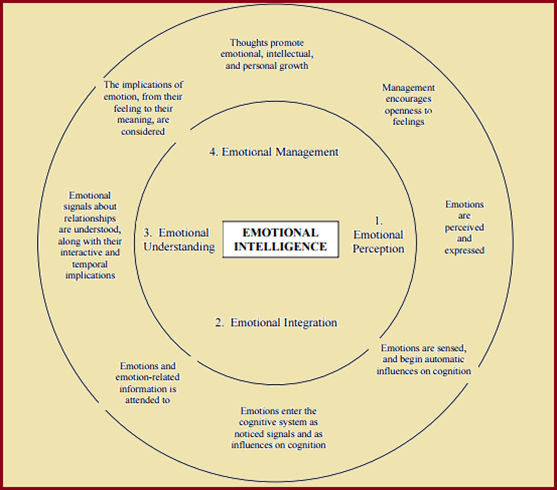
Peter Salovey and John Mayer first proposed their theory of emotional intelligence in 1990. It can be said that the term Emotional Intelligence was first introduced in the scientific literature in 1990. Since then, the development of models of emotional intelligence and research in this field has increased substantially. Pure theory of Salovey and Mayer of emotional intelligence integrates major ideas in the arena of Intelligence and emotion. It is said that intelligence involves the capacity to carry out abstract reasoning. From emotion research, emotions are indications that express regular and discernible meanings about relationships and that at a number of basic emotions are universal (Mayer, Salovey, and Caruso, 2002). They suggest that individuals vary in their ability to process information of an emotional nature and in their ability to relate emotional processing to a wider cognition. They then posit that this ability is seen to manifest itself in certain adaptive behaviours (Mayer, Salovey, and Caruso, 2000). Mayer and Salovey's notion of emotional intelligence is based within a model of intelligence, that is, it strives to define emotional intelligence within the confines of the standard criteria for a new intelligence. It proposes that emotional intelligence is comprised of two areas: experiential (ability to perceive, respond, and manipulate emotional information without necessarily understanding it) and strategic (ability to understand and manage emotions without necessarily perceiving feelings well or fully experiencing them).
Mayer and Salovey's (1997) Four-Branch Model of Emotional Intelligence
Goleman: A Mixed Model of Emotional Intelligence: Goleman (1995-2003) has promoted the notion of emotional intelligence and formulated it in terms of a theory of job and work performance. According to Goleman, five primary domains characterize emotional intelligence:
- Knowing one's emotions. People with greater certainty of their moods and feelings are better navigators of their lives. They can take good decisions and set realistic expectations.
- Managing emotions: People who have ability to cope with adverse or distressing emotions can soothe themselves at the appropriate time. They can shake off rampant anxiety, gloom or irritability. They show a form of "stress" hardiness.
- Motivating oneself: People with the capacity for self-efficacy not only manifest emotional self-control, but also use this to accomplish specific pre-set goals. This ability to stifle impulsiveness underlies accomplishments of all sorts.
- Recognizing emotions in others. People with the ability to distinguish other's emotions based on situational and expressive cues possess information which can be used to create desirable outcomes. Empathetic abilities come with the capacity to not only recognize but also share the emotions felt by others.
- Handling relationships. People with this skill can get things done with and through others. Over time, the consistent capacity to handle relationships will create leadership opportunities for the individual with this competence.
Goleman's (2001) Emotional Intelligence Competencies
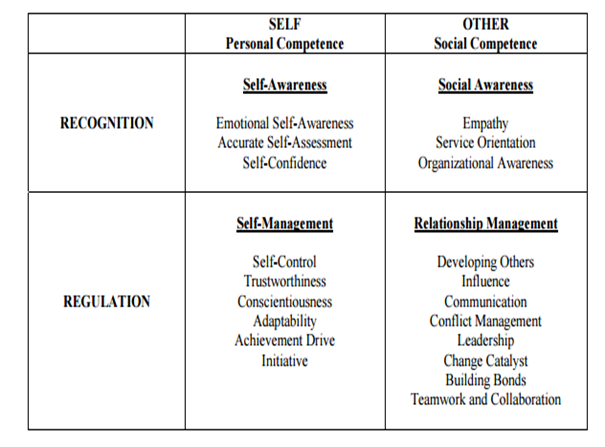
Goleman's work has been influential to develop the concept of emotional intelligence in the context of work organizations and administrative units. In this application of emotional intelligence, Goleman subtly shifts his discourse from multiple intelligences to multiple competencies. He groups work competencies into three categories that include purely technical skills (such as accounting and business planning); cognitive (such as analytical reasoning); and competencies demonstrating emotional intelligence (such as the ability to work with others and effectiveness in leading change). Goleman argues that emotional intelligence has importance when work is uncertain, increasingly interdependent and knowledge based. Goleman further argues that in the new economy, emotional skills are required to establish conditions for sharing knowledge and developing trust which is vital for the development of functional teams.
Emotional intelligence is measured using the Emotional Intelligence quotient (EQ) which is more of a description of the capacity or ability to perceive, then assess and eventually manage one's own and others emotions. Several measures of emotional intelligence are used in scientific research. Two of these measures are the Levels of Emotional Awareness Scale (LEAS) and the Self-Report Emotional Intelligence Test (SREIT).
Commonly Used Measures of Emotional Intelligence
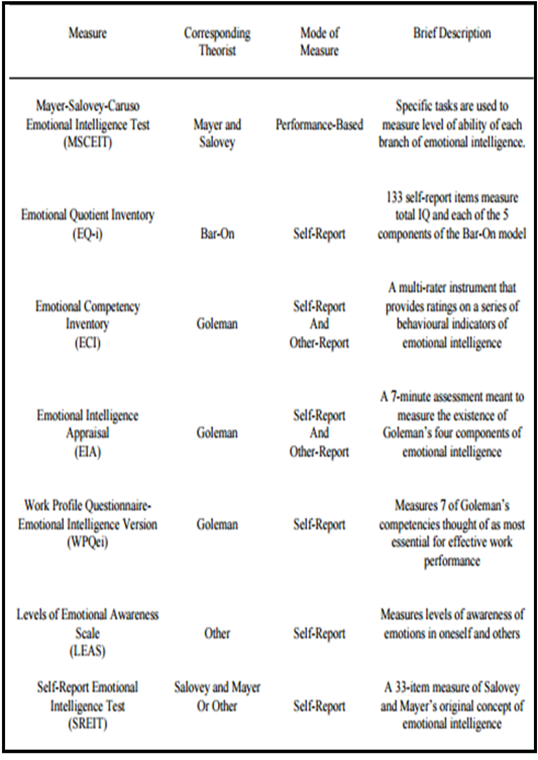
There are three main emotional intelligence models which include:
- Emotional intelligence Model based on Trait.
- Emotional Models based on Ability.
- Emotional intelligence from mixed models.
1. The Trait Emotional Intelligence model: Trait emotional intelligence or Trait emotional self-efficacy is described as "a constellation or behaviour dispositions and self-perceptions regarding a person's ability to recognize, process and utilize emotional-laden information" where the trait emotional intelligence should be measured within the framework of an individual's personality.
The trait emotional intelligence is measured by numerous tools of self-report and include the EQ, the Six seconds emotional intelligence assessment, the Swinburne University emotional intelligence test (SUEIT) and the Schuttle self-report emotional intelligence test (SSEIT). A trait emotional intelligence questionnaire (TEIQUE) that is in 15 languages was designed specially in an open- access manner to measure emotional intelligence compressively.
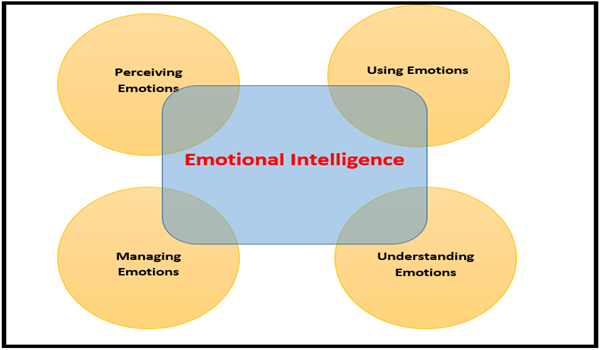
2. Emotional intelligence model based on ability: Salovey and Mayer reviewed their prior Emotional Intelligence definition and improved it to read as "the ability to perceive emotion, integrate emotion to facilitate thought, understand emotions and regulate emotion to promote personal growth" (Mayer, J.D. and Salovey, P.,1997). This model maintains emotions as vital information sources that enable a person to make good use of the social environment. According to the model, an individual's ability to process emotional information varies from one person to another and certain adaptive behaviours manifest themselves in this ability. The model thus goes further to propose four ability types that include:
- Perceiving of emotions
- Using of emotion
- Understanding emotions and
- Initiating the emotions
III. Mixed models of emotional intelligence: Included in the mixed emotional intelligence model are Golemans's Emotional Competencies and Bar-On's emotional-social intelligence model.
Several studies have shown that Emotional intelligence has considerable impact on the performance at work, helps to steer the social intricacies of the workplace, lead and motivate others, and outshine in career. It also affects physical health by managing the stress levels, which if left uncontrolled can lead to serious health problems. It is well established in numerous psychological reports that major step to improving emotional intelligence is to learn how to relieve stress which in turn will also improve your mental health. By understanding ones emotions and how to control them, person is able to express how to feel and understand others feeling. This permits communicating more successfully and developing stronger relationships, both at work and in personal life.
Application of emotional intelligence in administration and governance:
Many administrative officers are extremely talented, conceptually brilliant and have a very high IQ. They excel in computers, science and mathematics. But they have problem in making social relationships. Many of them are antagonistic and ruthless in their response to the outside world. They have little or no feeling for people around them. They feel physiologically uncooperative in their relationships and have no social graces or even a social personal life.Bulk of studies have demonstrated that Emotional intelligence is enumerated through deep listening to oneself and listening to others (Kramer 1995, 1999). People who are high in emotional intelligence recognize how to listen to their emotions and control their intensity so they are not influenced by others. Emotionally intelligent people know how to keep troublesome emotions in check. Emotionally intelligent people sense the effect their emotions have on others. Emotionally intelligence people know how to use their strengths and compensate for their weaknesses. Emotionally intelligence people listen to other people's emotions and can understand with them. Emotionally intelligent people act morally and build trust through honesty and consistency.
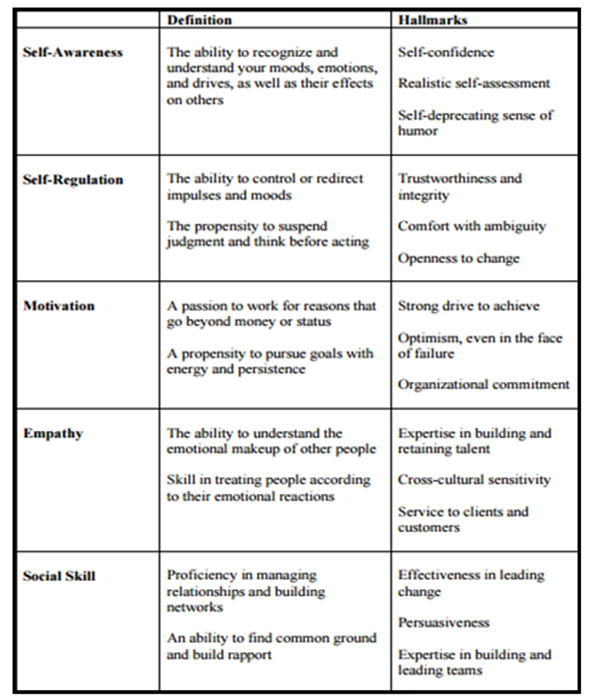
In the area of administration and governance, emotional intelligence has five main elements of emotional intelligence:
- Self-awareness.
- Self-regulation.
- Motivation.
- Empathy.
- Social skills.
As an administrator and leader, one should manage these elements.
1. Self-awareness: If people are self-aware, they always know their feelings and how emotions affect the people around them. Being self-aware people are in administrator or leadership position also means having a clear picture of their strengths and weaknesses.
2. Self-regulation: administrators and leaders who regulate themselves successfully hardly verbally attack others, make rushed or emotional decisions, stereotype people, or compromise their values. Self-regulation is all about staying in control. This element of emotional intelligence also covers an administrators and leader's flexibility and commitment to personal accountability.
To improve ability to self-regulate, person must
- Know values.
- Hold himself accountable.
- Practice being calm.
3. Motivation: Self-motivated administrators and leaders regularly work toward their goals. And they have extremely high standards for the quality of their work. Administrators can improve motivation by following method:
- Re-examine why they are doing certain act.
- Make sure that their goal statements are fresh and energizing (Goal Setting).
- Know where they stand.
- Be hopeful and find something good: Motivated leaders are usually optimistic, no matter what they face. Adopting this mind-set might take practice, but it's well worth the effort.
4. Empathy: Empathy is critical to manage a successful team or organization. Administrators and leaders with empathy have the ability to put themselves in someone else's situation. They support and develop the people on their team, challenge others who are acting unfairly, give constructive feedback, and listen to those who need it.
5. Social skills: Administrators and leaders must develop social skills. People who do well in this element of emotional intelligence are great communicators. They are just as open to hearing bad news as good news, and they are experts at getting their team to support them and be excited about a new mission or project. Administrators who have good social skills are also good at managing change and resolving conflicts tactfully.
Components of emotional intelligence (Daniel Goleman, 1998):
Although emotional intelligence has numerous benefits in administration and workplace, major drawback is testing of emotional intelligence. Main concerns with testing methods is the discussion on whether emotional intelligence is based on a person's temperament and personality, or whether it is a learned response developed through interpersonal skills and experiences. Testing based on the nature aspect will look at personality, emotional stability and conscientiousness of the person to determine emotional intelligence. The nurture advocates will look at socially accepted aspects in the immediate area, leadership skills, teamwork and learned interpersonal skills.
To summarize, Emotional intelligence is the ability to identify and understand emotions and their impact on behaviour and attitudes. Those who have a high degree of emotional intelligence are in tune with both their own emotions and the emotions of other people with whom they come in contact. Recently, focus on understanding emotions in organizations has resulted in increased attention to the role of Emotional Intelligence.