
Environmental Pollution And Degradation
World is facing severe problem of environmental degradation due to rapid increase in population and economic development that weakens the environmental resource.
Environment Pollution
Environment pollution is worldwide issue and it has adverse impact on the health of human populations (Fereidoun et al, 2007). Universal environmental pollution, including greenhouse gas emissions and acid deposition, as well as water pollution and waste management is deliberated as global public health problems, which should be examined from manifold perspectives such as social, economic, legislation, and environmental engineering systems, as well as lifestyle habits helping health promotion and reinforcing environmental systems to repel adulteration (Loux, 2011). It is observed that the problems of environmental pollution is intense in the developing world, where traditional sources of pollution such as industrial emissions, poor sanitation, insufficient waste management, polluted water supplies and exposures to indoor air pollution from biomass fuels affect humans (Samet, 2001). Recently, modern pollutants have emerged which are associated with traffic congestion and the use of modern chemicals in the home, in food, for water treatment and for pest control.
Air Pollution has emerged as growing global issue among environmentalists and researchers especially in developed countries since the decade of 1960 (Kan, 2009). It affects human and animal lives, natural ecosystems and the man-made environment. The main pollutants found in the air people breathe include, particulate matter, PAHs, lead, ground-level ozone, heavy metals, sulphur dioxide, benzene, carbon monoxide and nitrogen dioxide (European Public Health Alliance, 2009). Air pollution in urban areas has numerous health impact such as a shorter lifespan for city inhabitants (Progressive Insurance, 2005).
Air pollution is also responsible for climate change due to the enhanced greenhouse effect, acid rain, and the depletion of the ozone layer that constitute important global environmental problems. Mishra stated that fast growth in urban population, increasing industrialization, and rising demands for energy and motor vehicles are the deteriorating air pollution levels (2003). He further said that other factors, such as poor environmental ruling, less efficient technology of production, jammed roads, and age and poor maintenance of automobiles also increase pollution level. It is established that air pollution is caused of ill health and death by natural and man-made sources. Major man-made sources of ambient air pollution include tobacco smoke, combustion of solid fuels for cooking, heating, home cleaning agents, insecticides industries, automobiles, power generation, poor environmental regulation, less efficient technology of production, congested roads, and age and poor maintenance of cars and other automobiles. The natural sources include furnaces and waste disposals, forest and agricultural fires (European Public Health Alliance, 2009). Air pollution occurs both outdoors and indoors and is caused by human activities and natural mechanisms. Outdoor air pollution is described as the discharge of numerous air pollutants in to the atmosphere, in concentrations that threaten the health of living organisms or upset the function of the environment as a system leading to human health damages in various ways. Indoor air pollution is defined as the amount of chemical, biological and physical contaminants in the air inside a building. Indoor air pollution is more dangerous as compared to outdoor air pollution. Some of indoor air pollutant sources in houses including building materials, pressed wood products and furniture, central heating and cooling systems, several personal care or household cleaning products, painting colours, solvents, heating or cooking appliances (stoves, wood and gas burning fireplaces, gas heaters), tobacco smoke, office machines and other products used in daily activities (EPA, 2007).
Consequences of Air Pollution:
Air pollution cause many health issues. It is found that CO2 is a good transmitter of sunlight, but it also partially restricts infrared radiation going back from the earth into space, which produces the greenhouse effect that prevents a drastic cooling of the Earth during the night. Increasing the amount of CO2 in the atmosphere strengthens this effect and is expected to result in a warming of the Earth's surface.
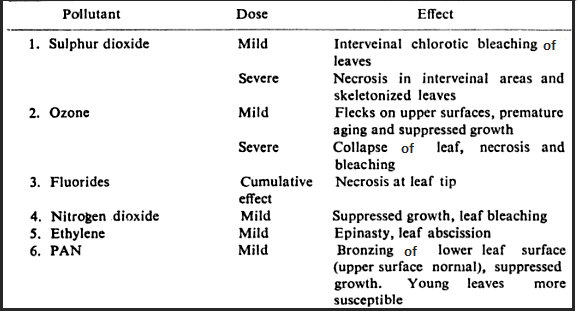
Air pollution has harmful impact on plant life. Sulphur di oxide is considered as most harmful pollutant (Rao, 1989).
Effect of pollutant on plants (Source: Rao, 1989)
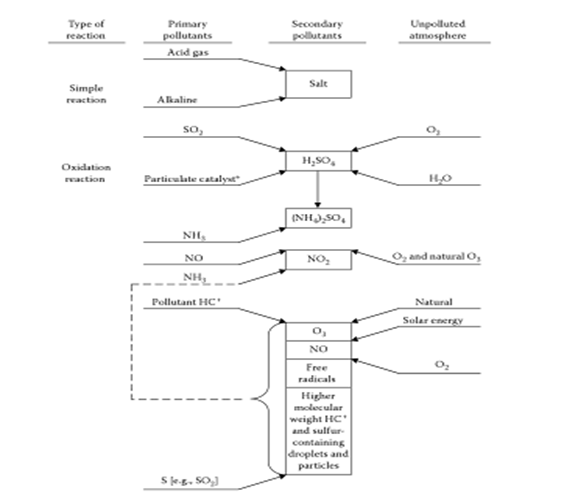
Air pollution monitoring is very necessary to control pollution. These techniques collect data by scientists to enable them to make informed decisions to manage overall quality of environment.
Air pollution monitoring and source categorization (Source: Bhola, et, al., 2010)
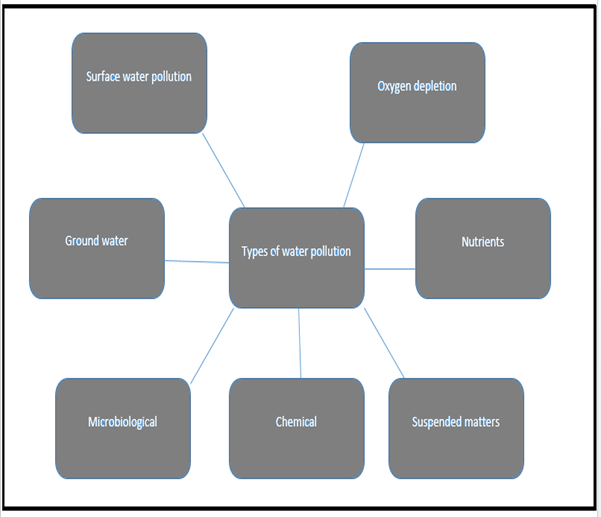
Water pollution: Water pollution is also a matter of concern for human life. Polluted water comprises of Industrial discharged wastes, sewage water, rain water pollution (Ashraf et al, 2010). Water can also be polluted by agriculture or households cause damage to human health or the environment. (European Public Health Alliance, 2009). This water pollution adversely impacts the health and quality of soils and vegetation (Carter, 1985). Pollutants in water include a wide range of chemicals, pathogens, and physical chemistry or sensory changes. Many of the chemical substances are toxic or even carcinogenic. Pathogens can obviously produce waterborne diseases in either human or animal hosts. The effects of water pollution are major cause of death for humans at global scale. Furthermore, water pollution affects oceans, lakes, rivers, and drinking water (Scipeeps, 2009). A drinking water contained a fluoride content ranging from 5.26 to 26.32 milligrams per litre and this is too high as compared to the World Health Organization�s standard of 0.6 to 1.7 milligram per litre (Rizvi, 2000). It has been found that Paper and pulp mills consume large amount of water and discharge liquid and solid waste products into the environment. The liquid waste is usually high in biological oxygen demand, suspended solids, and chlorinated organic compounds such as dioxins (World Bank, 1999).
Types of water pollution:
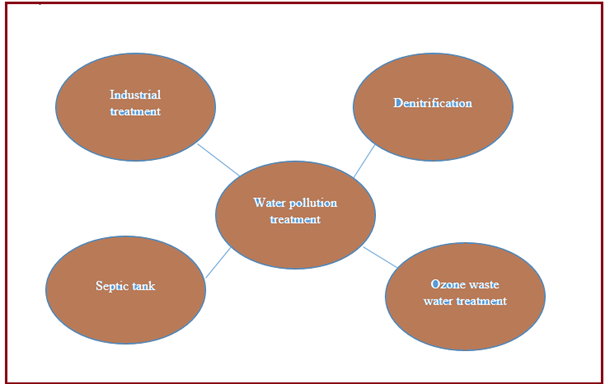
Treatment of water pollution: There are many ways by which water pollution can be treated such as industrial treatment, denitrification, septic tank, and ozone waste water treatment. Before raw sewage can be carefully released back into the environment, it must be treated properly in a water treatment plant. In a water treatment plant, sewage goes through a number of chambers and chemical processes to reduce the amount and toxicity of the waste. Denitrification is an ecological approach to avert the leaching of nitrates in soil, and stops ground water pollution with nutrients. Septic tanks treat sewage at the place where it is located and used to treat sewage from an individual building. Untreated sewage from a property flows into the septic tank and the solids are separated from the liquid. Environmentalists use Biological processes to degrade the solid matter. Another method to treat water pollution is well known Ozone wastewater treatment. An ozone generator break down pollutants in the water source. The generators convert oxygen into ozone using Ultraviolet radiation and Electric discharge field. There are numerous advantages of ozone to treat wastewater such as this technique kills bacteria successfully, oxidizes substances such as iron and sulphur. There are some drawbacks of adopting ozone to treat wastewater such as it requires energy in the form of electricity, cost money and cannot work when the power is lost and cannot remove dissolved minerals and salts.
Water pollution treatment
Land/ Solid waste Pollution: This type of pollution also shake environment. Inadequate management of solid waste is one of the main causes of environmental pollution (Kimani, 2007). Land pollution is one of the main forms of environmental calamity in current situation (Khan, 2004). Causes of Land Pollution include Mining and quarrying, Sewage waste, Household Garbage and Industrial Waste. Consequences of Land Pollutants are dangerous such as extermination of wild life. In land pollution, acid rain kills trees and other plants and vegetation that provides food and shelter is destroyed. It can seriously disturb the balance of nature, and, in extreme cases, can cause human mortalities. Pesticides can damage crops; kill vegetation and poison birds, animals, and fish. Most pesticides kill or damage life forms other than those intended. To prevent Land Pollution, it is advised that more and more land should be brought under farming. Trees should be planted everywhere. Waste matter should be disposed immediately and avoid drilling the Land for more underground water. People must avoid using more chemical fertilizers and Pesticides.
Noise pollution, soil pollution and light pollution also harm the environment at an alarming rate. Causes of Noise Pollution include aircraft noise, noise of cars, buses, and trucks, vehicle horns, loudspeakers, and industry noise, as well as high-intensity sonar effects which are extremely harmful for the environment, noise from construction and civil engineering works. Extreme noise pollution occurs due to technical advancement and the motor vehicle, which is responsible for about ninety percent of all undesirable noise internationally. Effects of Noise Pollution are Hearing Loss, High Blood Pressure, Stress, Sleep Disturbance, Colour Blindness. To Avoid Noise Pollution, the Government should ensure the new machines that should be noise proof. Air ports must be away from residential area. Do not sound horn symbol is to be in school roads. Soil pollution is described as the impurity of soil of a particular region. Soil pollution mainly is a result of penetration of damaging pesticides and insecticides, which deteriorate the soil quality, thus making it contaminated and unfit for use later. Main causes of soil pollution include Industrial wastes such as harmful gases and chemicals, agricultural pesticides, fertilizers and insecticides, ignorance towards soil management and related systems, unfavourable and harmful irrigation practices, improper septic system and management and maintenance of the same, leakages from sanitary sewage, acid rains, when fumes released from industries get mixed with rains, fuel leakages from automobiles, that get washed away due to rain and seep into the nearby soil, improper waste management techniques, which are characterized by release of sewage into the large dumping grounds and nearby streams or rivers.
Light pollution is described as excessive and incorrect artificial light (Mizon, 2002). It is caused due to extreme use of artificial lights by humans. The powerful artificial light which are used to brightens offices, factories, sports stadium, street, parks and sometime even housing complexes obscure the night sky.
The four components of light pollution are often combined and may intersect:
- Urban Sky Glow: The brightening of the night sky over inhabited areas.
- Light Trespass: Light falling where it is not intended, wanted, or needed.
- Glare: Excessive brightness which causes visual discomfort. High levels of glare can decrease visibility.
- Clutter: Bright, confusing, and excessive groupings of light sources, commonly found in over-lit urban areas. The proliferation of clutter contributes to urban sky glow, trespass, and glare.
Plethora of environmental studies have shown that environmental pollutants have various adversarial health effects. The most important harmful effects are prenatal disorders, infant mortality, respiratory disorders, allergy, malignancies, cardiovascular disorders, and increase in stress oxidative, endothelial dysfunction, mental disorders, and various other harmful effects. Though, short-term effects of environmental pollutants are usually underlined, wide range of hazards of air pollution from early life and their possible implication on chronic non-communicable diseases of adulthood should be underscored. Many studies have demonstrated that environmental particulate exposure has been linked to increased risk of morbidity and mortality from many diseases, organ disturbances, cancers, and other chronic diseases (Kargarfard, 2011). Consequently, experts advised to take immediate action and control the pollution. Otherwise, the waste products from consumption, heating, agriculture, mining, manufacturing, transportation, and other human activities will damage the environment.
Environmental Degradation
Environmental degradation is a consequence of the active inter play of socio-economic, institutional and technological actions. Environmental degradation is a process through which the natural environment is compromised in some way, decreasing biological diversity and health of the environment. Environmental degradation is described as the worsening of physical components of the environment brought in by human activities to such an extent that it cannot be set right by self-regulatory mechanism of environment. This process can be completely natural in origin, or it can be fast-tracked or caused by human activities. Many global organizations identify environmental degradation as major threats to communities, planets. Environmental changes may be driven by numerous factors such as economic development, population growth, and urbanization, intensification of agriculture, more energy use and transportation. Poverty is also major issue which creates environmental problems. The economics of environmental pollution, depletion and degradation of resources has been ignored as compared to the issues of growth and expansion. India is also facing problems of environmental degradation because of the considerable increase in its population.
Factors that Led Environmental Degradation
There are basically two factors namely:1. Natural factors such as drought, storms on sea, land and deserts such as hurricanes, tornadoes, carina and volcanic eruptions. These factors lead to land degradation through erosion.
2. Human factors which include deforestation, industrialization and urbanization. These factors lead to water, air and land pollution.
Types of Environmental Degradation
Types of environmental degradation: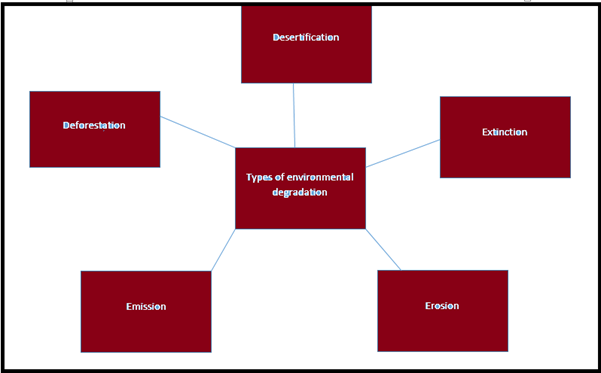
Deforestation
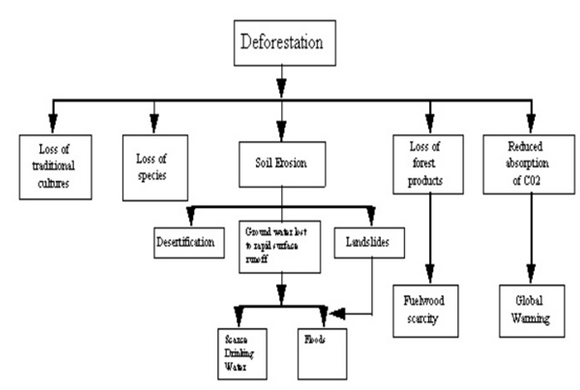
Deforestation is the process of clearance of forests by logging and/or burning. Deforestation occurs due to many reasons that include trees or derived charcoal are used as, or sold, for fuel or as a commodity, while cleared land is used as grassland for livestock, plantations of commodities, and settlements. The exclusion of trees without sufficient reforestation has resulted in harm to habitat, biodiversity loss and dryness. It has adversative impacts on bio-sequestration of atmospheric carbon dioxide. Deforested regions characteristically sustain substantial adverse soil erosion and frequently damage into wasteland.Causes of deforestation: There are several causes of current deforestation such as dishonesty of government institutions, the unfair distribution of wealth and power, population growth and overpopulation, and urbanization. Globalization is also major cause of deforestation, though there are cases in which the impacts of globalization have supported localized forest recuperate.
Extinction
It is the process by which a species, genus, or family, becomes extinct no longer existing and living in the world. It is the elimination and annihilation of something that previously existed in the world. In the arena of biology, it denotes specifically to the end of an evolutionary line, or a branch on the tree of life. The extinction of a species can have significant consequences for an ecosystem and even for the physical environment and climate, often leading to further extinctions.Desertification:
Desertification is the ruin of land in waterless and dry sub-humid areas due to many factors such as climatic changes and human activities. Desertification results primarily from man-made activities. It is mainly caused by overgrazing, over drafting of groundwater and diversion of water from rivers for human consumption and industrial use, all of these processes are fundamentally driven by overpopulation. Main effect of desertification is reduced biodiversity and weakened productive capacity, for example, by transition from land dominated by shrub lands to non-native grasslands.
Causes of desertification: Desertification occurs due to numerous factors, primarily anthropogenic causes, which began in the Holocene era and continues today. The primary reasons for desertification are overgrazing, over-cultivation, increased fire frequency, water impoundment, deforestation, over drafting of groundwater, increased soil salinity, and global climate change.
Multilevel set of causes of Desertification (Source: Camilla Toulmin, 1993)
Emmision
Emission is process in which human or natural forces discharge chemicals or other substances into the environment. Emission leads to pollution such as emission is caused when chemicals are released into the air. Many natural processes cause emissions. When a volcano explodes, it lets out acid, and acid, ash, and many toxic gases. When fires break out in forests, they release smoke, soot, carcinogenic hydrocarbons, dioxins, and carbon dioxide.Erosion
Erosion is the procedure of weathering and carriage of solids in the natural environment or their source and deposits them elsewhere. It generally occurs due to transport by wind, water, or ice, by down-slope creep of soil and other material under the force of gravity; or by living organisms, such as burrowing animals, in the case of bio-erosion.A certain amount of erosion is natural and, it is good for the ecosystem. Erosion is different from weathering, which is the process of chemical or physical breakdown of the minerals in the rocks, although the two processes may occur simultaneously.
Causes of environmental degradation
Due to increased activities of humans and release of harmful chemicals, environmental conditions deteriorated and impact on human health. There are many causes of environmental degradation. The speedy population growth and economic development in country are degrading the environment through the unrestrained growth of urbanization and industrialization, expansion and intensification of agriculture, and the obliteration of natural surroundings. Main reason of environmental degradation in India is unparalleled growth of population, which is unfavourably affecting the natural resources and environment. The increasing population and the environmental deterioration face the challenge of continued development without environmental damage. Population impacts on the environment is mainly through the use of natural resources and production of wastes and is related with environmental stresses like loss of biodiversity, air and water pollution and increased pressure on arable land.Another major cause of environmental degradation pointed out by environmentalists is Poverty. The circular link between poverty and environment is a tremendously complex phenomenon. Inequality may raise unsustainability because the poor, who rely on natural resources more than the rich, deplete natural resources faster as they have no real prospects of gaining access to other types of resources. Moreover, degraded environment can quicken the process of destitution, again because the poor depend directly on natural assets.
It has been observed that poor people migrate to urban areas due to lack of opportunities for profitable employment in villages and the ecological stresses. Extra-large cities are emerging and urban slums are expanding. Such rapid and unplanned development of cities has resulted in ruin of urban environment. It has broadened the gap between demand and supply of infrastructural services such as energy, housing, transport, communication, education, water supply and sewerage and recreational amenities, thus depleting the valuable environmental resource base of the cities. The result is the growing trend in worsening of air and water quality, generation of wastes, the proliferation of slums and undesirable land use changes, all of which contribute to urban poverty.
There are some economic factors that lead to environmental degradation. Environmental degradation is the consequence of market failure, that is, the non-existent or poorly functioning markets for environmental goods and services. In this framework, environmental degradation is a particular case of consumption or production externalities reflected by divergence between private and social costs (or benefits). Market misrepresentations created by price controls and subsidies may exacerbate the achievement of environmental objectives.
Transport activities intensely effects on the environment such as air pollution, noise from road traffic and oil spills from marine shipping. Transport infrastructure in India has expanded significantly in terms of network and services. Thus, road transport accounts for a major share of air pollution load in cities such as Delhi. Port and harbour projects mainly impact on sensitive coastal eco systems. Their construction affects hydrology, surface water quality, fisheries, coral reefs and mangroves to varying degrees.
Effect of agricultural development on the environment ascend from farming activities which contribute to soil erosion, land salination and loss of nutrients.
Effects of Environmental Degradation
1. Impact on Human Health: Human health is greatly impacted by the environmental degradation. Areas exposed to toxic air pollutants can cause respiratory problems like pneumonia and asthma. Most of people loss their life due to indirect effects of air pollution.2. Loss of Biodiversity: Biodiversity is vital to sustain balance of the ecosystem in the form of combating pollution, restoring nutrients, protecting water sources and stabilizing climate. Deforestation, global warming, overpopulation and pollution are few of the major causes for loss of biodiversity.
3. Ozone Layer Depletion: Ozone layer is responsible to shield earth from detrimental ultraviolet rays. The presence of chlorofluorocarbons, hydro chlorofluorocarbons in the atmosphere is causing the ozone layer to deplete. As it will deplete, it will emit harmful radiations back to the earth.
4. Loss for Tourism Industry: Speedy activities of tourism industry is also responsible for the worsening of environment that rely on tourists for their daily livelihood. Environmental damage in the form of loss of green cover, loss of biodiversity, huge landfills, increased air and water pollution can be a big turn off for most of the travellers.
5. Economic Impact: The huge cost that a nation may have to borne due to environmental degradation can have huge economic impact in terms of restoration of green cover, cleaning up of landfills and protection of endangered species. The economic impact can also be in terms of loss of tourism industry.
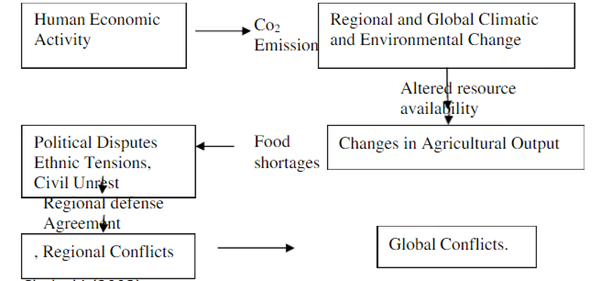
The potentials of human economic activity leading to regional and world-wide conflicts especially as the emission of dangerous gases into the atmosphere (environmental degradation) results in changes in agriculture production and inaccessibility of resources eventually causing food scarcities.
Impact of environmental degradation (Source: Chalecki, 2003)
To summarize, Pollution is due to harmful substances or products into the environment. There are several types of pollutions in the environment such as Water Pollution, Air Pollution, Soil Pollution, land pollution. Environmental degradation is the collapse of the earth or worsening of the environment through consumption of assets such as air, water and soil, the destruction of environments and the annihilation of wildlife.