
Linkages of Organised Crime with Terrorism
Crime and terrorism are critical issues for security officials and investigators all around the world. Earlier, the problems of organized crime and terrorism were considered as separate phenomena but after horrified incident of September 11th attacks, researchers have started linking these two as terrorized occurrence (Shelley et al., 2015). Numerous security studies, military and law enforcement seminars thoroughly debated the evolving threat of transnational organized crime or terrorism, but the important links between the two were hardly made. It was due to the fact that organized crime and terrorism are typically viewed as two different forms of crime because the main objective of organized crime is to gain economic profit while terrorism is an act that is motivated by ideological aims and a desire for political change (Bovenkerk and Chakra, 2015).
After the Cold War and the consequent decline in state sponsorship for terrorism, the use and imitation of organized crime approaches has been an important factor as methods to generate profits for terrorist groups and equally, organized crime has adopted terrorist methods of violence. Organized crime is generally focused mainly on economic profit, acquiring material benefits and obtaining as much of an illegal market share as possible, by the use of severe wrongdoings such as Drug trafficking, fraud, violence etc. (Baylis and Smith, 2001). Whilst terrorism motivated primarily by ideological purposes and by a desire for political change, by the use of violence, in the form of hijacking, bombing and other criminal acts.
Organised crime: Organized crime is described as any group having a corporate structure whose main aim is to obtain money through unlawful activities often surviving on fear and corruption. Today, organized crime is business at large scale that is conducting global commerce for the trafficking of illegal services and products as well as developing the associated supply chains. Criminal organizations are conducting commerce across traditional nation-state boundaries that permit illegal groups to work in synchronisation with other like groups. This coordination is called transnational crime. According to The FBI, "organized crime as any group having some manner of a formalized structure and whose primary objective is to obtain money through illegal activities" (FBI 2006). These crimes include: Bribery, Murder, Counterfeiting, Embezzlement of Union Funds, Mail Fraud, Wire Fraud, Money Laundering, Obstruction of Justice, Murder for Hire Drug Trafficking, Prostitution Sexual Exploitation of Children, Alien Smuggling, Trafficking in Counterfeit Goods, Kidnapping Gambling, Arson Robbery, Sports Bribery Extortion, Drugs, and Theft from Interstate Shipment/Interstate. Organized crime is based on several factors ((Bailey and Godson 2000, Pp: 599):
- The number of participants perceived scale of illicit operations;
- The level of business development and organizations attributed to the social agents who live off of the illegal business or who at some point participate in that business;
- The danger these participants may pose in specific situation for the existence or effective exercise of the rule of law.
Organized crime is intimidating global economies due to the emergence of progressive technology, growing businesses, and political pressures that generated new avenues for these criminal organizations to flourish. Organized crime involves a continuing enterprise operating for the production and sale of illegal goods and services (Jones, 2015). Organised crime has been thoroughly studied in USA since several decades. The U.S Task Force Report, 1967, appropriately describes the organised crime as "a society that seeks to operate outside the control of the American people and their government. It involves thousands of criminals working within structures as complex as those of any large corporation, subject to laws more tightly enforced than those of legitimate governments. Its actions are not impulsive but rather the result of intricate conspiracies, carried on over many years and aimed at gaining control over whole fields of activity in order to amass huge profits". Organised crime is the joint result of the commitment, knowledge and actions of three components:
- The Criminal groups
- The Protectors
- The Specialist support
The criminal group operates beyond the life time of individual members and is structured to survive changes in lead ship. The criminal group depends on continuing criminal activity to generate income. Thus, continuing criminal scheme is intrinsic in organized crime. Some activities are such as supplying illegal goods and services.
Organized crime in India is stratified, organized and administered as any other corporate office in legal business world (Gandhirajan, 2004). In India, organized crime is committed to seeking protection money, contract killing, boot-legging, gambling, prostitution and smuggling, and drug trafficking, illicit arms trading, money laundering, transporting illegitimate activities based essentially on its readiness to use physical force and violence. By corrupting public officials and thereby monopolising or near monopolising, organised crime aims to secure for itself power. Later, the money and power it creates are used to infiltrate legitimate business and several other related activities. Organised crime has been committed in India since earlier time in some form or another. It has, however, assumed its dangerous form in modern times due to several socio-economic and political factors and progressions in science and technology. Even though rural India is not resistant from it, it is essentially an urban phenomenon. In India, there is no broad law to control organised crime in all its dimensions and manifestations, There is substantive law regarding criminal scheme. According to reports, many criminal gangs of organized crimes are operating in India. These criminal gangs have been operating in India since ancient times. The gangs of 'thugs' usually preyed on travellers or wayfarers while traversing lonely regions that passed through thick jungles. The 'thugs' travelled in gangs, large or small, usually un-armed and appearing to be pilgrims, ascetics or other harmless wayfarers.
Dawood Gang: Dawood is the most dominant, Bombay gangsters having a country wide networks with linkages overseas. He is one of the most powerful gangsters involved in transnational crimes mainly narcotic drugs, smuggling, extortion and contract killing. He is operating from Dubai and some other countries since 1985. He had a phenomenal rise in short time.
Arun Gawli Gang: His gang is involved in the collection of protection money from rich businessmen and contract killings.
Other gangs are gmar Naik Gang, Chota Rajan Gang, Veerappan Gang of Karnataka, Om Prakash Srivastava or Babloo, Gang of Uttar Pradesh, Latif Gang of Ahmedabad, Rashid Gang of Calcutta.
Terrorism: Terrorism is an act that appears to be intended to terrorise or force a civilian population to influence policy of a government by extortion or to affect the conduct of the government by assassination or abduction. Theoretical studies have documented that Terrorism usually results from multiple causal factors - not only psychological but also economic, political, religious, and sociological factors, among others. There is even a hypothesis that it is caused by physiological factors. Because terrorism is a multi-causal phenomenon, it would be simplistic and erroneous to explain an act of terrorism by a single cause, such as the psychological need of the terrorist to perpetrate an act of violence (Hudson 1999, 15). It is established in theoretical studies that terrorists are not a consistent group but their roots are diverse.
Terrorism counteracts the most basic values of cultivation. Previous literatures have shown that terrorism is practiced since ancient time and executed in various forms. During 20th century, the occurrence of terrorism was focused on bully or their representatives. Terrorism is evolved as new perilous missile to undermine the government activities and disrupt important services. When reviewing literature, various intellectuals and security professionals elaborated the concept of terrorism. According to The U.S. Department of State (DOS), terrorism as premeditated, politically motivated violence perpetrated against non-combatant targets by sub-national groups or clandestine agents, usually intended to influence an audience (U.S. DOS 2003). The Federal Bureau of Investigation described the occurrence of terrorism as the unlawful use of force or violence against persons or property to intimidate or coerce Government, the civilian population, or any segment thereof, in furtherance of political or social objectives (Jarboe 2002).
The Department of Defense (DOD) delineates the calculated use, or threatened use, of force or violence against individuals or property to coerce or intimidate governments or societies, often to achieve political, religious, or ideological objectives (FM 1-02 2004, 1-186). The UN described terrorism as criminal and unjustifiable, wherever and by whomsoever committed; terrorism are criminal acts intended or calculated to provoke a state of terror in the general public, a group of persons or particular persons for political purposes are in any circumstance unjustifiable, whatever the considerations of a political, philosophical, ideological, racial, ethnic, religious or other nature that may be invoked to justify them (UNODC 2006c). The objective of terrorist organizations is different from the ideology they embrace and the country they are active in. General purpose of terrorism seems like to overthrow its target regime and to establish a new system in the light of their ideology. (Dilmaç 2006, 451)
Some causal factors impact contrarily on various types of terrorist groups. Many researches designated that technical advancement significantly affects the level of ideological terrorism in any country. In some cases, terrorist groups attack due to one set of causes and continually active for over a period of time for different reasons. In many cases, terrorism emerged due to conflicts among groups. Some reports demonstrate some groups involve in terrorism because they have tried other alternatives. Other groups adhere to terrorist because they have learned from the experiences of others, usually through the news media. Terrorist organizations such as Osama bin Laden and his al Qaeda organization developed that is fundamentally different from previous type terrorist groups to target innocent public. With lethal attack of the September 11 Bin Laden accomplished his political objective.
There are numerous types of terrorism:
- State Terrorism: It is an act committed by government. Many researchers consider that the actions of governments can be labelled terrorism such as using the term 'terrorism' to mean violent action used with the predominant intention of causing terror. It has been said that State terrorism" is as contentious concept as that of terrorism itself. Terrorism is often, describe four characteristics that include the threat or use of violence, a political objective, the desire to change the status quo, the intention to spread fear by committing spectacular public acts, and the intentional targeting of civilians.
- International Terrorism: These are identified as acts planned, executed across more than one nation. International terrorism is the illegal use of force or violence committed by a group or individual, who has some connection to a foreign power or whose activities transcend national boundaries, against persons or property to intimidate or coerce a government, the civilian population, or any segment thereof, in furtherance of political or social objectives.
- Domestic Terrorism: Acts planned, executed in one nation. Domestic terrorism involves groups or individuals who are based and operate entirely within nation like the United States and Puerto Rico without foreign direction and whose acts are directed at elements of the U.S. Government or population. The arsenals that domestic terrorist groups have access to and have stockpiled in caches around their areas of operation are difficult. Extremists have amassed explosives, machine guns, missiles and other weapons. These groups are also trained by experienced war veterans, police officers, "guns for hire," ex-special forces members, demolitions experts, and other highly skilled survivalist that train them in the art and science of war.
- Religious Terrorism: Religious terrorism is a type of terror activity that is done on motivations and goals that have a mainly religious character or influence. In contemporary situation, after the decline of concepts such as the heavenly right of kings and emergence of nationalism, terrorism has more often been based on anarchism, nihilism, and revolutionary politics. Since 1980, however, there has been an upsurge in terrorist activity motivated by religion. Reports of the Global Terrorism Index have shown that since 2001, religious extremism has overtaken national separatism to become the main driver of terrorist attacks around the world.
Modern literature relates to terrorism in the context of religion and its Diasporas. This is not surprising given the events that have dominated global attention since over a decade. In addition to Islamic terrorist groups, the Tri-Border Area (TBA) provides a haven that is geographically, socially, economically, and politically highly conducive for allowing organized crime and the corrupt officials who accept their bribes or payoffs to operate in a symbiotic relationship that thrives on drug and arms trafficking, money laundering, and other profitable criminal actions. It can be established that Terrorism is a global phenomenon and in 2013 attacks were carried out in 87 countries with 60 of these experiencing deaths from terrorism.
terrorist incidents, 2000–2013 (Source: GTD)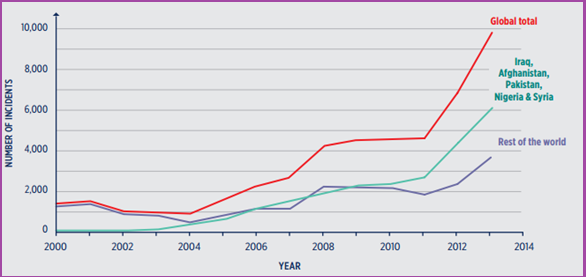
Reports indicated that terrorism is increased by 70 per cent in India from 2012 to 2013, with the number of deaths increasing from 238 to 404. The number of attacks also increased, with 55 more attacks in 2013 than 2012. However, the majority of terrorist attacks in India have low casualties. In 2013, approximately, 70 per cent of attacks were non-lethal. There were attacks by 43 different terrorist groups such as Islamists; separatists; and communists. Communist terrorist groups are by distant the most frequent perpetrators and the main cause of deaths in India. Usually, the difference with Pakistan over Jammu and Kashmir is main cause of Islamic terrorism. In 2013 three Islamist groups were responsible for around 15 per cent of deaths. This includes Hizbul Mujahideen, an Islamist group allegedly based in Pakistan with a membership of around 15,000. This group was the only group in India to use suicide tactics in 2013. North east region of India has for the last three decades seen continual ethno-political unrest from ethnic secessionist movements. Separatist groups including in Assam, Bodoland, Kamtapur and Meghalaya were responsible for 16 per cent of deaths.
Previously, inspirations for terrorism and organized crime were different. The main intent of terrorism was to chase power; gaining of power and to use power through political, ideological, religious or ethnic means but organized crime was for money and power through illegal movement.
In present global condition, most terrorists are involved in some form of organized crime and a rising number of organized crime lobbies are engaging in political violence. While some terrorist organizations may only profit briefly or indirectly from organized crime, others unite and become a hybrid organization displaying both characteristics.
Similarity in the features of organised crime and terrorism:
- Both have hierarchical structure.
- In both act, there is limited membership.
- In both criminal act, there is a violence to achieve goals.
- There are Rules and regulations that define behaviour.
Linkages of Organised Crime with Terrorism:
In present global climate, high profile crime is committed to gain power and generate huge funds to live lavishly. Researchers have stated that there is strong link between terrorists with criminal organizations. Primarily, crime and terrorism are slightly related in meaning and strategic application; however, historically these organizations have differing motivations, and ideologies. Crime is usually encouraged by financial gain, while terrorism has been primarily motivated by philosophy such as Maoism, Marxism, or theological ideologies. According to John R. Wagley, "terrorists are increasingly seen as supporting themselves through criminal activity, because a growing number of extremists may feel justified in committing the criminal activities themselves, on the grounds that such acts square with their ultimate terrorist aims" (Wagley 2006). In an example of funding for the March 2003 Madrid train attacks came from drug dealing and the Dubai-based Indian mobster, Aftab Ansari, is believed to have helped fund the September 11 attacks with ransom money earned from kidnapping" (Wagley 2006, 3).
Crime terror continuum (Aubrey, 2004)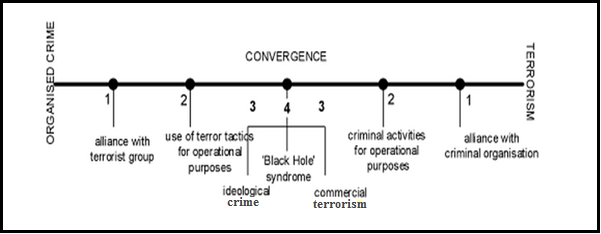
Criminals see other benefit from linkage of organized crime and terrorists activities is that this relationship is established techniques, tactics, and procedures (TTP) against law implementation, the government, and social institutions in a particular nation. These techniques, tactics, and procedures are vital as criminals can teach terrorists the weaknesses of the country's rule of law, how to operate without recognition under the radar, the least detectable communication methods such as cell phone burners, Morse code, child messengers, encrypted websites like Hushmail, or letters with simple encryption and how to use already well-developed criminal supplies such as arms dealers, the narcotics trade, and money laundering services.
The occurrence of globalization and dreaded incident of the 9/11 on the World Trade Center have made the conditions to link between organized crime and terrorism to grow at huge scale. This trend is rising due to the U.S. governmental crackdown on rebellious funding in which "153 individuals, organizations, and financial supporters of terrorism" access to financial networks were severely reduced or eliminated by the 29-nation Financial Action Task Force (Bush 2001, paragraph 24-31). Other reasons are the need to create revenue, the use of well-developed criminal supply chains and networks, and the interdependent relationship that criminals and terrorists share.
In general, there appear to be three ways that the crime-terror nexus interact:
- Through shared tactics and methods;
- Through the process of transformation from one type of group to the other over time; and JMLC
- Through short- or long-term transaction-based service-for-hire activities between groups (Mullins, 2009).
There are many similarities between terrorist organizations and organized crime groups. Uyar, (2006) describe these stands as following:
- First similarity is that both operate secretly. Although both terrorist groups and criminal organizations have a strong central leadership, they are mainly based on cell structures to achieve their own goals. Day to day operations are carried out by members of small cells.
- Both use violence and produce mostly civilian victims.
- Intimidation and fear are characteristics of both groups.
- They use similar tactics, such as kidnapping, assassination, extortion.
- Terrorist and crime group organizations use front organizations such as legitimate businesses or charities.
- Both uses similar ways to conceal profits and fund raising.
- The activities of both groups are in cross the national-regional transnational divide; both groups require safe havens, and as a result both tend to take advantage of Diaspora communities.
- Both groups are aided by corrupt officials whose services provide mutual benefits, such as access to fraudulent documents, including passports and other identification and customs documents to smuggle goods and weapons.
It can be said that both terrorism and organized crime use of similar methods without working together. Each group relies upon support and expertise of others. There is a symbiotic relationship in both acts. Groups develop cooperative relationship to defend each other. As described earlier in this paper. The FBI definition of organized crime does not relate to the many of description of terrorism; however, the activities of organized crime match-up with the acts of terrorism, in that terrorism uses fierce acts to attain a particular goal. It is well understood in various reports that Crime and terrorism have occurred under various conditions and are multi-causal occurrence. Theories of Anomie, Repressive Regime, Conflict, and Differential Opportunity. Elaborated the elements of the crime and terrorism phenomenon.
There is huge supportive literature that shows the linkage between organized crime and terrorism. Both crime and terrorism have occurred under parallel conditions. These conditions comprise of economic adversity, social stratification, oppressive regimes, weak or limited law enforcement, socioeconomics, and the politics of a particular region. Both crime and terrorism allow the marginalised or the subjugated to gain life success by choosing another path that breaks the institutional barriers of entry using innovative, illegal approaches. These methods provide opportunities for ideological wins, financial advantage and vertical movement in a society. Subsequently, the socio-political and socioeconomic environment can actually empower criminal and terrorist elements. Other factors like high joblessness, poverty, the lack of education, the lack of opportunities, high infant mortality rates, and cultural/religious relations; all contribute to criminal and terrorist trends.
According to Uyar (2006), terrorist organizations are distinguished from organized crime groups on the basis of following features:
- Terrorist organizations are normally ideologically, politically, or religiously motivated while organized crime groups are profit oriented. Dissimilar to this fact, terrorist groups that usually have non-financial goals: publicity, dissemination of an ideology, the destruction of a society or regime, and simply spreading terror and intimidation, drug traffickers and organized crime groups first and foremost seek monetary gain.
- Terrorist groups often wish to contest with governments for legitimacy, but organized crime organizations do not.
- While terrorist organizations usually enjoy media attention, organized groups do not.
- Generally, terrorist victimization is less discriminate than the violence used by organized crime groups.
Nexus between organized crime and terrorism increases also due to many factors such as globalization in which free flow of trade and human provide opportunity for both to intermingle, communication rebellion through internet, end of cold war that reduce state financing of terrorist therefore terrorist indulge in criminal activities to fill financial needs and lastly, global war on terror. Terrorism and organized crime shared techniques. Internet and cyberspace are crucial tools for recruitment, propaganda, planning, logistics, fund raising, and money laundering.
Linkages of organised crime with terrorism in India:
In Northeast, numbers of insurgent groups over a time have morphed into crime syndicates. All militant group run a similar government or have their areas of influence involved in collecting money directly from people, and from government funds due to misgovernance, government officials are threatened or bribed to award contracts and also important commodities like rice and kerosene are sold to public at much higher rate. There are growing number of extortion, kidnap, contracts, black marketing transnational drugs and arms to finance terrorism. In India, there is infamous entry points from Southeast Asia to India- moreh and Chittagong hill tract especially coxs bazaar. When discussing about Kashmir, unlike northeast reliance of funds from extortion and other related means is minimal. External funds by Pakistan and other countries especially gulf.
Other linkage is through the spread of fake currency. Terrorists are the main agent of this currency. Indian mujahidin resorted to crime to raise funds. This includes robberies and kidnapping. Maoists terror movement also uses coercion, robberies of banks and kidnapping to collect huge funds.
To summarize, Union of organized crime and terrorism is major menace for international safety and peace. These crimes are growing at rapid rate. It can be concluded from reviewing major facts of these crimes that Organized crime is a rising as international phenomenon and, as it intersects with terrorism, an increasingly dangerous force. Although terrorism and organized crime are dissimilar horrified criminal activities, the important fact is that terrorists and criminal networks overlay and collaborate in some situation. Regrettably, the interaction of terrorism and organized crime is increasing because of parallel conditions give rise to both and because terrorists and organized criminals use similar approaches to promote their operations. Unfortunately, their alteration of incorporating fraud into their larger criminal goals is deadly. Just as terrorists pool their abilities and resources to achieve synergistic outcomes. Its abolition can be possible only if collaboration is attained at global scale and counter-terrorism programs along with development schemes are executed at fundamental level.